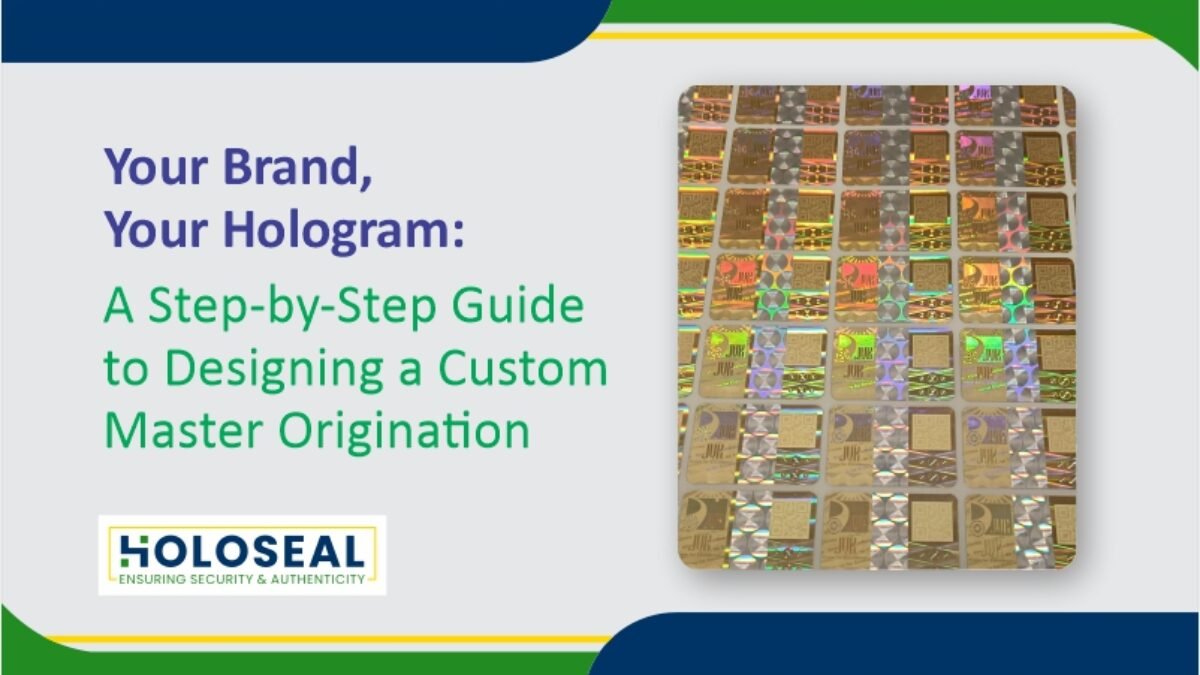
In the world of security holography, the term “Master Origination” represents the genesis of uniqueness. This is not a simple graphic file; it is the singular, proprietary template from which all your hologram stickers are born. Choosing a custom hologram design isn’t just about picking a pattern—it’s about creating an unclonable optical fingerprint for your brand. At Holoseal, we demystify this critical process, guiding you through the collaborative journey of designing a master origination that is as secure as it is symbolic.
This guide illuminates the step-by-step transformation of your brand’s identity into a physical, light-based shield.
Step 1: The Strategic Discovery & Threat Assessment
Before a single line is drawn, we begin with a conversation. Our experts work with you to define:
- Your Security Objectives: Are you fighting counterfeiting, preventing diversion, ensuring tamper evidence, or all three?
- Your Brand Aesthetic: What is the visual language—minimalist, ornate, technical, organic—that the hologram must complement?
- Your Verification Ecosystem: Who needs to authenticate this? Consumers, retailers, internal inspectors, or law enforcement?
This phase ensures the final design is not just beautiful, but strategically engineered to address your specific risks.
Step 2: Conceptual Design & Feature Integration
Here, artistry meets security science. Our design team translates your brand assets into holographic concepts. We explore how your logo, iconography, or signature patterns can be reimagined with kinetic movement and depth. Concurrently, we map the integration of security features:
- Overt Elements: The primary, visible graphics with dynamic visual effects.
- Covert Layers: Planning the placement of hidden features like microtext, UV-reactive areas, and laser-readable zones.
This stage produces initial visual mock-ups, showing how the hologram will look and behave in light.
Step 3: The Technical Artwork & Data Preparation
This is the pivotal technical phase. Approved concepts are translated into precise, mathematical data. Using specialized software, our engineers construct the hologram’s design in a vector-based format, defining:
- The exact spatial frequency of the diffraction grating.
- The geometry and depth of each embossed layer to create 3D effects.
- The precise placement and rendering of guilloche patterns, microtext, and scrambled indicia.
This digital file is the blueprint; its complexity is what makes mass replication impossible.
Step 4: The Master Origination Process
The digital blueprint is now physically etched. This is performed in a controlled environment using a process called electron-beam lithography. A focused beam of electrons writes the intricate, nano-scale pattern onto a light-sensitive material coated on a glass or nickel substrate. This creates the “master shim.” This master is a negative of the final hologram and represents the crown jewel of your security—a unique, physical asset that we safeguard with the highest protocols.
Step 5: Electroforming & Shim Production
From the master, we create working tools. Through an electroforming process, the pattern is transferred onto durable nickel “production shims.” These shims are the actual rollers or stamps used in the embossing machines to mass-produce your holographic film. Multiple shims can be created from the master to ensure consistent, high-volume production without degrading the original.
Step 6: Embossing, Metallization & Finishing
The production shim is used to emboss (press) the intricate pattern onto a special PET film. This embossed film is then metallized (often with aluminum) to make the diffraction pattern reflective, creating the signature shimmer. Finally, the film undergoes finishing processes:
- Demetallization: Selective removal of metal to create transparent or semi-transparent windows, often used for integrating QR codes or for aesthetic effect.
- Lamination & Adhesive Coating: The holographic layer is laminated to a destructible void film and coated with a high-tack, tamper-evident adhesive.
- Custom Printing: Additional covert UV inks or serialized numbering are applied.
Step 7: Quality Assurance & Authentication Protocol
Every batch undergoes rigorous verification. We test for optical clarity, adhesion strength, and the proper function of all covert features. Crucially, we help you establish a verification protocol—a simple guide for your team and partners on how to use each security layer (from visual check to UV light to laser verification).
The Holoseal Partnership: Your Vision, Engineered into Light
Designing a custom master origination is a partnership in innovation. It’s the process of encoding your brand’s essence into an optical code that cannot be hacked, only honored. The result is far more than a sticker; it is a proprietary asset, a deterrent, and a powerful statement that your brand’s integrity is non-negotiable.
Your brand deserves a signature in light. Let’s create it together.
Begin the journey of designing your unclonable security mark. Connect with Holoseal’s experts at www.holoseal.in.