
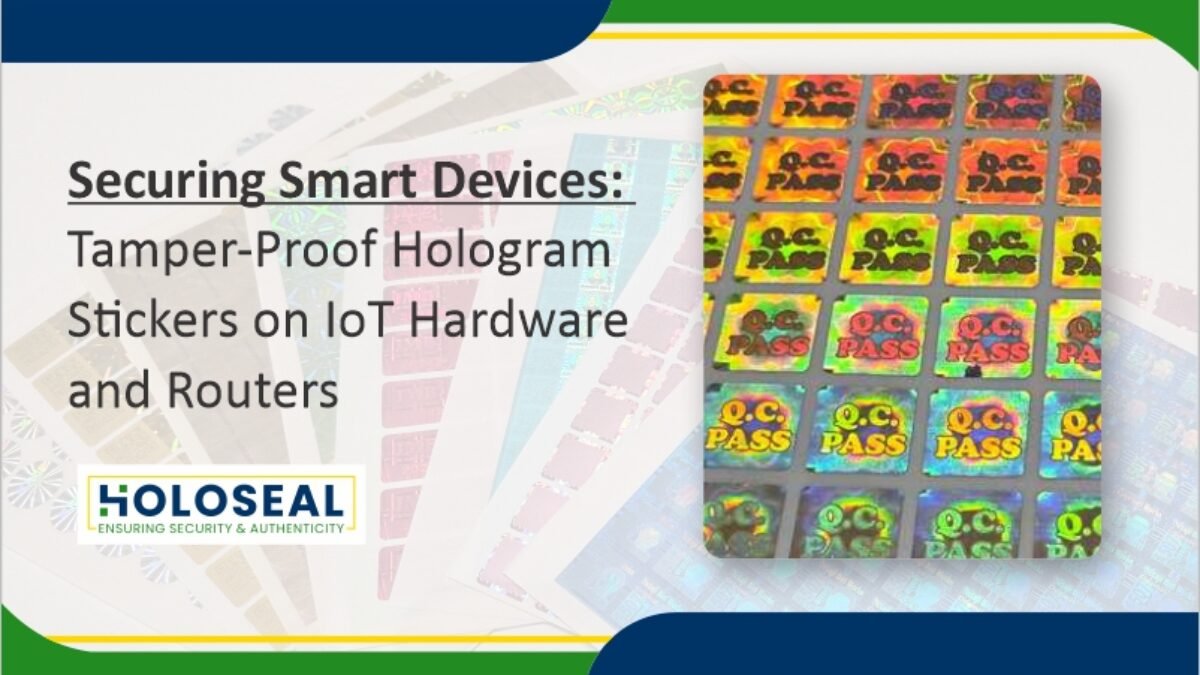
The Internet of Things (IoT) has transformed from a futuristic concept into the backbone of modern infrastructure. Smart thermostats regulate our homes, connected cameras watch over our properties, industrial sensors monitor critical machinery, and network routers direct the flow of our digital lives. Yet this web of connectivity harbors a vulnerability often overlooked: the physical device itself. A router with tampered firmware can silently exfiltrate every password entered on your network. A compromised industrial sensor can feed false data that halts production or creates safety hazards. At Holoseal, we engineer a critical defense for this hardware—custom tamper-proof hologram stickers designed specifically to secure IoT devices against unauthorized access, component substitution, and supply chain infiltration.
The Unique Vulnerabilities of Connected Hardware
The proliferation of smart devices has created unprecedented attack surfaces. Unlike software vulnerabilities that can be patched remotely, physical compromises often go undetected for months or years. A device intercepted during shipping, fitted with malicious components, and resealed can enter your facility appearing completely legitimate. Traditional security focuses on network protection, but the hardware itself remains the weakest link.
IoT devices present specific security challenges that demand specialized solutions:
- Persistent Connectivity: Compromised devices maintain network access, potentially exfiltrating data long after tampering occurs.
- Complex Supply Chains: Components travel through multiple distributors, integrators, and installers before reaching their final destination.
- Field Service Exposure: Authorized repairs create opportunities for unauthorized component swaps if tampering goes undetected.
- Regulatory Requirements: Healthcare, finance, and critical infrastructure sectors face growing mandates for hardware integrity verification.
The Physical Security Gap
Most organizations invest heavily in cybersecurity—firewalls, encryption, intrusion detection—while treating physical device integrity as an afterthought. Yet the most sophisticated encryption becomes meaningless if the hardware itself has been compromised before it ever connects to your network. A device with a malicious chip soldered onto its circuit board will happily encrypt your data before transmitting it to an attacker’s server.
This physical security gap demands solutions that are both forensic and practical. A tamper-proof hologram sticker serves as the frontline sentinel—providing immediate visual evidence of any attempt to breach the device’s integrity.
The Holoseal IoT Security Architecture
At Holoseal, we engineer custom hologram stickers specifically for the unique demands of networking hardware and smart devices. Our approach combines advanced optical security with industrial-grade durability to create solutions that protect devices throughout their entire lifecycle.
Overt Visual Authentication for Instant Recognition
The first line of defense begins with what the eye can see. Our custom holograms feature sophisticated optical effects that are immediately recognizable yet practically impossible to replicate using standard printing equipment. Each label incorporates brand-specific designs with shifting colors and three-dimensional depth that serve as instant authenticity markers for receiving personnel, installers, and inspectors.
The visual complexity serves a dual purpose. It provides frontline staff with a quick and reliable method to verify hardware authenticity, while simultaneously raising the barrier for counterfeiters who might attempt to pass off compromised equipment as genuine. A generic rainbow sticker can be sourced anywhere; a custom-engineered holographic pattern with proprietary artwork cannot.
Tamper-Evident Engineering That Leaves Evidence
The true security value of our IoT labels lies in their behavior when tampered with. Each sticker is engineered as a destructible system—a precisely calibrated combination of materials designed to fail irreversibly upon any removal attempt.
The construction begins with a high-tack permanent adhesive that forms an unbreakable bond with the device surface. Above this sits a fragile film layer, often incorporating a pre-printed pattern. When someone attempts to peel the label—whether to access internal components, swap circuit boards, or replace the sticker on counterfeit hardware—the adhesive’s grip proves stronger than the film’s internal cohesion.
This controlled failure manifests in unmistakable evidence:
- Revealed VOID Patterns: A latent message emerges on both the label and the device surface, providing undeniable proof of interference.
- Holographic Fracturing: The optical layer shatters into fragments, making reapplication impossible and leaving clear forensic traces.
- Patterned Residue: Custom adhesive formulations leave behind honeycomb or brand-specific residue patterns that cannot be reapplied cleanly.
This tamper-evident mechanism transforms every label into a silent witness. A device that arrives with an intact label carries the assurance of authenticity. A device with a disrupted or missing label announces its compromise instantly, without requiring specialized equipment or technical expertise to interpret.
Industrial-Grade Durability for Real-World Conditions
Smart devices live everywhere—from climate-controlled data centers to sun-baked outdoor installations, from factory floors exposed to oils and solvents to vehicle telematics systems subject to constant vibration. Our labels are engineered to maintain their security function across this entire spectrum of environments.
Material selection begins with the substrate. We utilize multi-layer polyester and metalized film constructions that resist tearing, abrasion, and environmental degradation. Unlike paper-based labels that deteriorate over time, our holographic films maintain their optical properties and structural integrity for years.
Adhesive formulations are matched to specific application surfaces. For powder-coated metal enclosures, we specify adhesives optimized for low-surface-energy materials. For plastic housings, we select formulations resistant to plasticizer migration. For outdoor installations, we incorporate UV stabilizers that prevent adhesive breakdown from sunlight exposure.
Environmental testing validates performance across:
- Temperature Extremes: Bonds remain secure from -20°C to 80°C, ensuring integrity through shipping, storage, and operation.
- Chemical Exposure: Resistance to industrial cleaning agents, oils, and solvents prevents degradation in manufacturing environments.
- Moisture Resistance: Waterproof construction options protect devices exposed to humidity, rain, or washdown procedures.
- Abrasion Protection: Scratch-resistant top coatings maintain optical clarity through handling and installation.
This durability ensures that the security label remains an effective integrity indicator throughout the device’s entire operational lifespan—not just at the moment of installation.
Digital Integration for Advanced Verification
Physical tamper-evidence provides the first layer of security, but modern supply chains demand more. By integrating digital authentication within our holographic labels, we enable end-to-end traceability that extends from the manufacturing line to the final installation point.
Each label can incorporate a unique, encrypted QR code or DataMatrix symbol printed directly onto the holographic substrate. These codes carry device-specific information—model numbers, manufacturing dates, batch identifiers, and unique serial numbers—that can be verified against secure cloud databases.
When receiving personnel scan a device, the authentication platform performs multiple checks:
- Is this code valid and active?
- Has this device been verified before?
- Does the scanned location match the expected distribution channel?
- Does the code format match established patterns?
Any anomaly triggers immediate alerts. A device scanned multiple times suggests label duplication. A scan in an unauthorized territory indicates diversion. A code that doesn’t match database records flags potential counterfeiting.
For higher-security applications, we offer RFID integration within the tamper-evident label construction. This combines optical authentication with radio-frequency identification, enabling bulk scanning of pallets while maintaining individual device integrity verification.
Covert Security Layers for Forensic Investigation
Beyond visible authentication and digital verification, our labels incorporate features invisible to the naked eye but accessible to authorized personnel. These covert layers provide definitive proof of authenticity for security teams, customs officials, and forensic investigators.
Microtext embedded within the holographic pattern appears as solid lines until magnified, revealing brand names, batch codes, or security messages legible only under 10x or greater magnification. UV-reactive inks create hidden insignia that fluoresce under specific ultraviolet wavelengths. Laser-readable codes store encrypted information detectable only with dedicated handheld verifiers.
These covert features serve multiple purposes. They enable discreet verification during audits without alerting unauthorized observers. They provide forensic evidence in legal proceedings against counterfeiters. And they create additional layers of complexity that raise the bar for sophisticated attackers attempting to reverse-engineer the security system.
Application Strategy: Placement That Matters
The effectiveness of a tamper-proof label depends not only on its construction but on its placement. Strategic positioning maximizes security value while maintaining practical functionality.
For routers and networking equipment, optimal placement often covers access panels or critical seams. A label spanning the gap between housing halves prevents undetected opening. A label covering screw heads or service ports ensures any internal access leaves visible evidence.
For IoT sensors and smart devices, placement must account for installation requirements. Labels should not interfere with mounting brackets, cable connections, or user interfaces. We work with manufacturers to identify locations that provide maximum security coverage without impeding device functionality.
For field-serviceable equipment, multi-label strategies can distinguish between factory-sealed integrity and authorized service access. Different label designs or placement patterns create visible records of service history while maintaining security for critical components.
Real-World Implementation: Protecting Network Infrastructure
Consider a typical enterprise deployment scenario. A company orders fifty routers for a facility upgrade. The devices ship from the manufacturer, pass through a distributor, and arrive at the installation site. At each transfer point, personnel visually verify label integrity. Any device with a damaged, missing, or incorrectly patterned label is immediately quarantined for investigation.
Upon arrival, installation technicians scan each device’s QR code, confirming authenticity against the manufacturer’s database. The system logs each scan with timestamp and location, creating an auditable trail from factory to installation.
Months later, routine maintenance reveals one router with suspicious behavior. Investigators examine the device and discover its hologram label shows subtle signs of tampering—a faint VOID pattern barely visible under specific lighting. Forensic analysis confirms the device was intercepted, fitted with malicious hardware, and resealed. The compromised unit is immediately removed from the network, and the supply chain investigation traces the breach point.
This scenario illustrates the layered protection that Holoseal labels provide. The tamper-evident feature caught what visual inspection missed. The digital authentication enabled supply chain tracking. Together, they prevented a potentially catastrophic network breach.
The Cost of Compromise: Why Prevention Matters
The financial impact of hardware tampering extends far beyond the cost of the compromised device itself. A single breached router can expose an entire network, leading to data breaches, regulatory fines, legal liability, and irreparable reputational damage.
Consider the potential consequences:
- A compromised router in a financial network could expose thousands of customer accounts.
- A tampered industrial sensor could cause production downtime costing millions per day.
- A breached medical device could compromise patient safety and trigger FDA investigations.
- A network infiltration traced to compromised hardware could void insurance coverage and invite shareholder lawsuits.
Against these potential losses, the investment in tamper-evident security becomes not an expense but essential insurance—a small cost to prevent catastrophic outcomes.
The Holoseal Commitment to IoT Security
At Holoseal, we understand that for connected devices, physical security and digital security are inseparable. A device that can be physically compromised cannot be trusted digitally, regardless of the encryption or firewalls protecting it.
Our custom tamper-proof hologram stickers are engineered as comprehensive security solutions, not generic labels. Each design begins with a thorough assessment of the device’s specific vulnerabilities, usage environment, and supply chain journey. We consider factors ranging from surface materials and application methods to verification protocols and integration with existing authentication systems.
The result is a security solution tailored to your specific requirements—providing visible assurance to frontline personnel, forensic evidence for investigators, and digital traceability for supply chain managers.
Conclusion: Engineering Trust in Connected Hardware
The Internet of Things promises unprecedented connectivity and capability. But this promise depends on trust—trust that the devices powering our networks, controlling our systems, and managing our data are exactly what they claim to be.
A router with a compromised component isn’t just a faulty device. It’s a silent betrayal of that trust. An industrial sensor feeding false data isn’t just a maintenance issue. It’s a potential catastrophe waiting to unfold.
Holoseal’s tamper-proof hologram stickers provide the foundation for that trust. They offer visible, verifiable, and unforgeable assurance that your hardware is genuine and uncompromised. They transform every device into its own integrity witness, silently recording any attempt at violation.
In a world where everything connects, everything must be protected. Let Holoseal help you secure the devices that power your world.
Secure your connected hardware with engineered integrity. Partner with Holoseal to develop custom tamper-proof hologram stickers for your IoT devices. Visit www.holoseal.in to begin the conversation.