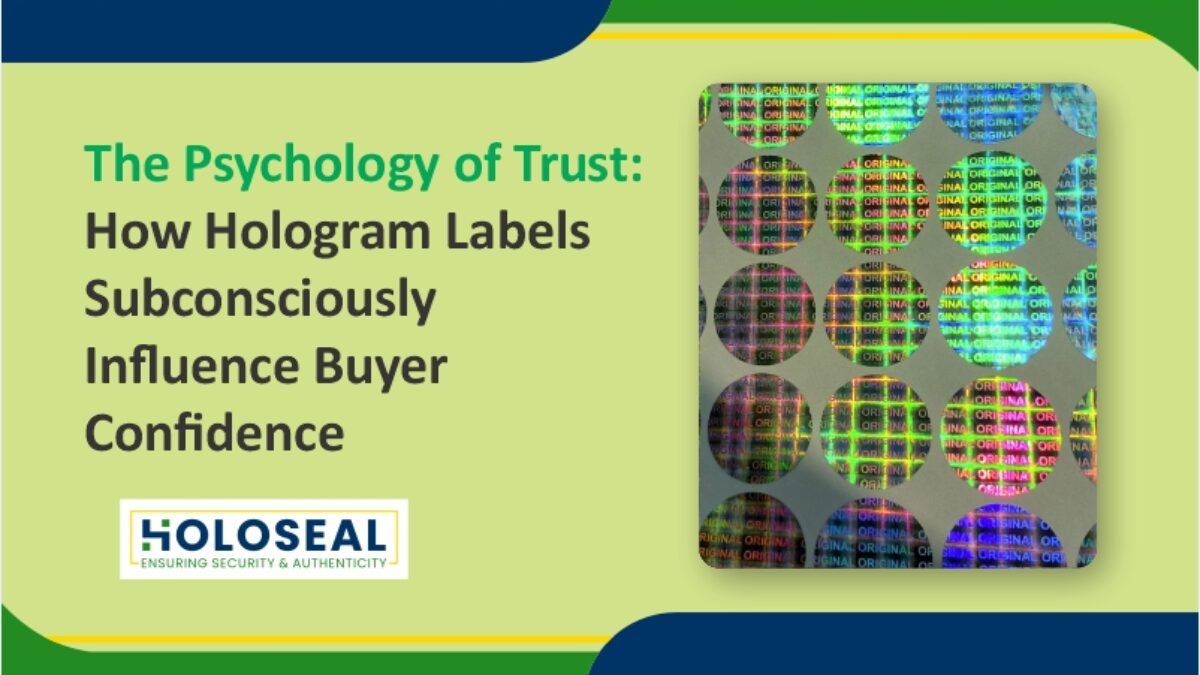
Trust is not a rational decision. It is an instinct—a split-second, subconscious judgment formed long before the conscious mind engages. In the micro-moments when a consumer picks up a product, their brain is scanning for signals. Is this real? Is this safe? Is this worthy of my money? In this silent, high-stakes negotiation, a custom hologram label speaks volumes without uttering a word. At Holoseal, we engineer more than security; we engineer psychological certainty.
Beyond its technical function as an anti-counterfeit device, a custom hologram label serves as a powerful, subliminal anchor of authenticity. Understanding this psychology reveals why the presence—and quality—of a hologram directly influences buyer confidence, brand loyalty, and perceived value.
The Instinctive Need for Assurance
Human beings are hardwired to detect patterns and anomalies. From our earliest ancestors, recognizing what was “safe” versus “threat” was a survival imperative. This neurological wiring remains active in the modern marketplace. When a consumer encounters a product, their brain unconsciously asks: Is this what it claims to be?
A generic, poorly printed, or easily peelable label triggers a subtle, often subconscious, red flag. Conversely, a high-definition, custom-engineered hologram that shifts with light and resists peeling sends a clear, instant signal: This is protected. This is genuine. This is valuable.
This response is rooted in heuristic processing—mental shortcuts that allow consumers to make rapid decisions. The hologram acts as a trust heuristic, a visual shorthand that bypasses complex analysis and delivers a simple verdict: authentic.
The Halo Effect of Quality Security
Psychology research identifies a phenomenon known as the halo effect, where a single positive attribute influences perception of other unrelated attributes. A premium, intricately designed hologram label creates a halo that extends to the product itself.
When a consumer sees a sophisticated, color-shifting, custom-contoured hologram, their brain unconsciously associates this precision with the product’s quality. If the brand invested in such detailed, beautiful security, the reasoning goes, surely they invested equally in product formulation, manufacturing, and customer care. The hologram becomes a proxy for overall brand integrity.
This effect is magnified with tactile engagement. A label with smooth lamination, crisp edges, and secure adhesion invites touch. This physical interaction—haptic validation—reinforces the perception of quality. The product feels protected, substantial, and real.
The Transparency Paradox: Seeing is Believing
Advanced techniques like demetallization, which creates transparent windows within the hologram, introduce another psychological dimension: controlled transparency. By allowing the consumer to see the product or packaging beneath the security seal, the brand communicates confidence. It says, We have nothing to hide.
This visible authenticity triggers a neurological reward response. The act of verifying—tilting the label to watch the image shift, spotting the hidden logo, reading the microtext under a phone’s magnifier—engages the consumer in active discovery. This participatory authentication creates a sense of personal validation and satisfaction. The consumer isn’t just told the product is real; they prove it to themselves.
Scarcity and Exclusivity Signaling
Custom holograms, by their very nature, signal scarcity. Unlike generic, off-the-shelf stickers available to any buyer, a bespoke holographic master exists only for one brand. This exclusivity is subconsciously perceived by the consumer.
In behavioral economics, scarcity increases perceived value. A product marked with a unique, non-replicable seal is instinctively understood as more rare, more special, and more desirable. This is particularly potent in luxury, limited-edition, and premium consumable markets, where the hologram transforms from a security feature into a badge of belonging to an exclusive class of authentic goods.
The Deterrence Signal to the Unconscious Mind
Interestingly, the psychology of trust operates on two levels: the consumer and the counterfeiter. A sophisticated, multi-layered hologram sends a powerful deterrent signal not just to conscious fraudsters, but to the unconscious perception of effort. Criminals assess risk-reward ratios. A product defended by a complex, custom hologram signals high effort, high expertise, and high likelihood of detection and prosecution. It broadcasts: This brand is vigilant. This brand fights back.
This perception alone diverts counterfeit activity toward softer, less defended targets, indirectly protecting your consumers from ever encountering fakes.
Holoseal: Engineering Trust into Light
At Holoseal, we recognize that every hologram we create carries this psychological weight. This is why we obsess over precision, clarity, and complexity. A blurry edge, a weak adhesive, or a simplistic pattern doesn’t just fail technically; it fails psychologically. It whispers doubt instead of shouting confidence.
We engineer our custom holograms to trigger the specific neurological responses that build trust: wonder at the kinetic beauty, reassurance at the tamper-evident crack, satisfaction at the hidden reveal, and pride in the verified purchase.
Your hologram is often the last thing a consumer sees before they buy. It is the final, silent witness to the transaction. Make it speak with authority, beauty, and unwavering certainty.
Trust is not claimed. It is demonstrated. Demonstrate yours with Holoseal. Visit www.holoseal.in to engineer your brand’s silent ambassador of confidence.